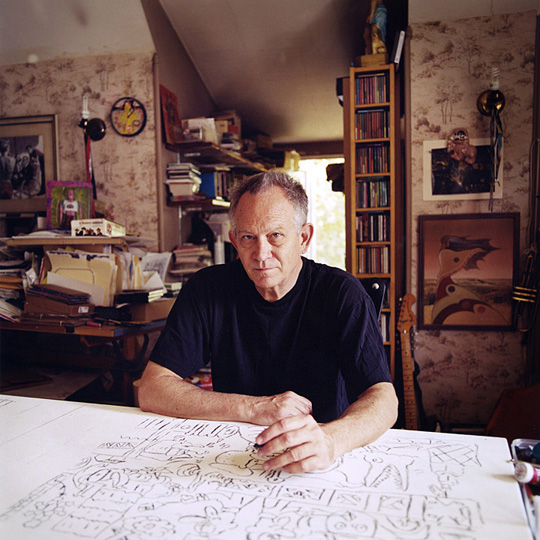
Thanks to illustrator Elizabeth (Sattler) Thieme,who wanted to pass along a blog post in Unbored, which features drawing tips by Gary Panter.
Showing posts with label craft. Show all posts
Sunday, October 21, 2012
Gary Panter's drawing tips
Wednesday, October 3, 2012
Grief in Fiction book from Denise Jaden
After
presenting on the topic of Grief in Fiction at a recent Pro Series
meeting, YA author Denise Jaden has compiled and expanded her notes on the
subject,
included exercises and key points, and is releasing it as a new author's
resource in ebook and paperback.
In her first nonfiction book, Writing With A Heavy Heart: Using Grief and Loss to Stretch Your Fiction, Jaden explores the stages and
outlets of grief and how to implement them into your fiction to create
more
interesting characters and a more engaging plot. Some topics of this
book include: grieving before the loss, spiritual matters, and how grief
affects different ages, personality types and gender.
Writing With A Heavy Heart: Using Grief and Loss to Stretch Your Fiction is available at the following links:
The paperback version is available at Create Space, as well as through
Amazon. (The price is the same on both, $6.99)
The e-book is available for $2.99 at:
And it will be coming soon to Barnes & Noble, iTunes, and Sony (but you can pick up a copy that will work on pretty much any electronic reading device through Smashwords.)
Note: It is a workbook, including exercises, but all versions of the book and e-book include a link where you can print the exercises for your own use.
Help Denise spread the word, and if you get something out of it, she'd love to hear about it! Find out more at http://www.denisejaden.com
Friday, May 11, 2012
Going Deeper: A Process Rather Than A Technique
I just had to share a few excerpts from this amazing post, which author Robin LaFevers wrote over at Writer Unboxed.
"Going deeper involves exposing oneself, but by degrees rather than all at once. A sense of peeling back a little skin, one layer at a time, seeing how much it stings, acclimating, then doing the whole thing over again and revealing a little more...
In order to do that, we have to be willing to explore our self—what are our issues? No really. The ones we don’t like to face or talk about. The ones that make us squirm, or we’re reluctant to admit even to our therapist. I hate to be the one to tell you, but those are where some of our most powerful writing will spring from... Yeah, you have to look there."and
"If you’re not pushing yourself hard enough that you sometimes feel like giving up, then maybe you’re not pushing yourself hard enough."She then goes on to detail seven techniques that helped her dig deeper in her own writing. Be sure to read the full post here.
Labels:
craft,
deeper,
giving up,
Robin LaFevers,
technique,
Writer Unboxed
Monday, April 23, 2012
Matt de la Peña: Hey, Author Person, Get Out Of My Way
Matt de la Peña followed up his Friday Fiction Intensive, focusing on dialogue, and his Saturday Keynote address with a terrific breakout session on the use of the narrator in fiction--getting out of the way of your characters and clearing the stage for them to do the work.
Matt spoke to the importance of the author being patient, of stepping back in the writing so as not to show off to the reader--allowing the character, setting and action to reveal the story and create more space for the reader to participate in the narrative.
Some nuggets I took away from his session:
- Start a scene (or the book) as late as possible and end it as early as possible: get in, get your beats and get out
- The reader wants to be thrust directly into the story; they want to watch and discover. Are you starting your book too soon?
- The idea of the writer and the reader being in collaboration – stepping back from the work allows for a wider interpretation on the part of the reader, and that’s a good thing.
- In dialogue, what’s inside the quotation marks is the character. What follows (the tag: she said for example) is the writer. Make that tag, and the author’s presence, as spare as possible.
Notes by Tina Hoggatt
Labels:
2012 annual conference,
craft,
matt de la peña
Sunday, April 22, 2012
Helen Landalf – Keeping it Real: Bringing Authenticity to Fiction
Helen Landalf (Flyaway, published by Houghton Mifflin Harcourt) identified three elements of authenticity in fiction and illustrated each with examples from regional author’s published books.
“Most of us can just feel when a story is authentic – it’s like a punch in the gut.”
“If a story feels authentic the reader has the reader firmly in the dream of the story.”
Elements of authenticity
• Factual accuracy – dates, locations, technical details
• Sensory Realism – specific sensory details that evoke experience for readers.
• Emotional Truth – enables readers to feel story’s emotions on a gut level.
Helen walked us through methods of factual research, as well as approaches to accessing emotional truths from our own lives and using them in the creation of our characters. She walked us through several writing exercises that allowed us to think about and process authenticity in our own. She closed by asking the question: How authentic is authentic enough?
Her answers:
• This is fiction, remember?
• Don’t show off your research.
• Let authenticity serve your story – don’t sacrifice your story to serve the truth.
“If we ground our stories in accurate facts and emotional experiences we can create stories that will be authentic and connect to the reader.”
The session was thoughtful and generous in spirit, reminded of the importance of getting both the facts and emotional details right, and gave the participants some takeaway tools of inquiry for use in their own writing.
(Notes by Tina Hoggatt)
Labels:
2012 annual conference,
craft,
helen landalf
Friday, May 21, 2010
Michele Torrey: story beginnings, part 2
She's continuing the lesson at her blog with a discussion of hooks:
Read the rest.
For me, picking out a new book is as simple as reading its first page. Does it grab me? Do I want to read more? Do I want to read it badly enough to: a) check the book out? b) spend my hard-earned money on it?
As writers, it’s our job to draw the reader in, to make them care enough to keep turning the pages. One of the tricks-of-the-trade is to ask a story question. Story questions are statements that beg answering, situations that must resolve. Story questions can be monumental or minuscule and are woven throughout a story from beginning to end. When a story question is posed at the beginning of a book, it is called a hook. In general, hooks should occur within the first few sentences of the beginning of a story. Here are three examples of hooks (all first sentences):
* “The morning the wagon came to take Monette away, the air was biting crisp and a sheen of frost covered the canefields.” — The Dreaming by Michele Torrey (manuscript) (The hook: Why is a wagon coming to take Monette away, and where is it going to take her?)
* “When he was nearly thirteen, my brother Jem got his arm badly broken at the elbow.” – To Kill A Mockingbird by Harper Lee (The hook: How did Jem break his arm?)
* “It was almost December and Jonas was beginning to be frightened.” — The Giver by Lois Lowry (The hook: Why is Jonas beginning to be frightened?)
Read the rest.
Wednesday, May 12, 2010
Michele Torrey on story beginnings
Looking over the first pages of your story? Michele Torrey has great advice on where to start:
We’ve all read them: books that stupify the senses for the first few pages or — ack! — the first few chapters. Like the literary troopers we are, we wade through those mind-dulling pages, meanwhile muttering incantations, It will get better . . . Any minute now something wonderful will happen . . .
If even the pros fall prey to such yawningly slow beginnings, how much more susceptible is the novice writer? Very, as it turns out. Often novice writers begin their stories thinking that they have to tell us everything up front in order for us to understand what’s going on. I’ve read middle grade manuscripts in which twenty or more characters are introduced in the first chapter alone, not because those characters were necessary to the chapter, mind you, but because the writer was under a “can’t-leave-anything-out” evil spell. The irony is, these tell-all openings are less intelligible than if the writer used a “need-to-know” approach.
So where should you begin your story? The general rule of thumb is to begin your story at the moment your character experiences a dramatic life change:Read the rest.
You would be surprised at how little information is really needed before the story is off and running.
- On the day the girl’s father mysteriously disappears.
- On the day the high school valedictorian opens the letter from Harvard, declining him admittance.
- On the morning of the fire.
Wednesday, April 21, 2010
How you can improve your characters' epiphanies
Darcy Pattison has a longish post on the art of the epiphany--that moment in a story where your character reveals something vital. Here's the top:
And here's the rest.
“And then, it suddenly dawned on her.”
That phrase is the ultimate cliche for a character epiphany. The term epiphany was originally a religious term referring to the physical appearance of a deity. In fiction, it’s the point at which truth appears before a character; the character learns or understands something.
Elaine Marie Alphin, author of Creating Characters Kids Will Love (Writer’s Digest) and several novels, says, “The epiphany is the moment of self-realization; it’s when the character’s change and growth hits him or her, even if the character doesn’t fully understand it.”
And here's the rest.
Saturday, April 10, 2010
Getting serious about series #scbwiwwa
Kevin Emerson, Suzanne Young, J. Elizabeth Mills, and Trudi Trueit are talking about their work writing and editing book series.
Suzanne Young: her quirky character led to the creation of a series from a single book (THE NAUGHTY LIST). Write relatable characters you want to be around. If she'd known it was being a series, she might have set it up more, and it wouldn't have felt as satisfying to read.
Kevin Emerson: He used to get psyched out about creating unique characters. It helps to be thinking in a genre. He had some rules he could use or change. He had some models to work from when he did OLIVER NOCTURNE. It was helpful for him to work with incremental elements (offering a big "prize" development at the end of the books). He also goes back to his character's age and thinks about what makes for good trauma/conflict (road trips and dances! oy!)
Trudi Trueit (SECRETS OF A LAB RAT): Find characters who are really honest. She writes out a character sheet--all the things her characters like. What's in Scab's pocket? What does his room look like? One of her characters has a lab/bedroom with piles of laundry and stacks of fossils. This makes characters come to life. "Sometimes you just start with one character and it develops as a series." Once you get that series going, you're locked in. So make sure the supporting cast is a good one.
Liz Mills: For the STABLEMATES series, Liz travels back to the age she's writing about and remembering the feelings of envy and jealousy, and how to work it into a story. The quest for perfect hair, for example, makes for good episodic content.
Suzanne Young: her quirky character led to the creation of a series from a single book (THE NAUGHTY LIST). Write relatable characters you want to be around. If she'd known it was being a series, she might have set it up more, and it wouldn't have felt as satisfying to read.
Kevin Emerson: He used to get psyched out about creating unique characters. It helps to be thinking in a genre. He had some rules he could use or change. He had some models to work from when he did OLIVER NOCTURNE. It was helpful for him to work with incremental elements (offering a big "prize" development at the end of the books). He also goes back to his character's age and thinks about what makes for good trauma/conflict (road trips and dances! oy!)
Trudi Trueit (SECRETS OF A LAB RAT): Find characters who are really honest. She writes out a character sheet--all the things her characters like. What's in Scab's pocket? What does his room look like? One of her characters has a lab/bedroom with piles of laundry and stacks of fossils. This makes characters come to life. "Sometimes you just start with one character and it develops as a series." Once you get that series going, you're locked in. So make sure the supporting cast is a good one.
Liz Mills: For the STABLEMATES series, Liz travels back to the age she's writing about and remembering the feelings of envy and jealousy, and how to work it into a story. The quest for perfect hair, for example, makes for good episodic content.
Wednesday, March 24, 2010
Monday, March 22, 2010
Oops! Are you writing a cliched fantasy?
Take the fifty-question quiz by David Parker. A few sample questions:
- Does nothing happen in the first fifty pages?
- Is your main character a young farmhand with mysterious parentage?
- Is your main character the heir to the throne but doesn't know it?
- Is your story about a young character who comes of age, gains great power, and defeats the supreme badguy?
- Is your story about a quest for a magical artifact that will save the world?
- How about one that will destroy it?
Friday, March 19, 2010
Bruce Hale's newsletter has a great piece on writing novels
The Chet Gecko author sends out a newsletter about storytelling, and I especially liked this week's featured essay by Kathi Appelt. It's about what it takes to write a novel.
To sign up for Bruce's newsletter, visit his site.
Meanwhile, here's that essay:
RAISE THE STAKES, HONEY!
I have been a writer my whole life long, beginning with writing on walls as a toddler to writing professionally as an adult. In that life-long career, I have written articles, picture books, non-fiction, poetry, essays, short stories, a memoir, and even a song or two.
But for years and years the novel was a form that absolutely eluded me.
NOVEL PROBLEMS
For a long time, I told myself that I didn't need to write a novel. After all, I had plenty of published work to stand on, and I had plenty of ideas for new works.
But I was kidding myself, because in my heart of hearts, it was a novel that I wanted to write. So, I took courses, I bought how-to books, I went to workshops. I did all of the required groundwork. Why couldn't I crack this genre?
In the meantime, I had drawer after drawer, boxes stacked upon boxes, of half-finished novels that were just that: half-finished.
It seemed like I could create wonderful characters, interesting landscapes, and great, colorful details. My characters, despite their goals, just didn't seem to make much progress. I'd get about half way through and then my story would lose steam and whimper into oblivion.
It wasn't until I took an on-line course with master teacher Dennis Foley that I realized that the essential element missing from my work was tension.
GETTING TENSE
Now, plots are plots. I knew how to create plots. They involve a character who is moving toward a goal. And as Dennis so aptly puts it: "a goal is nothing more than whatever your character is trying to achieve, overcome or acquire." Easy peasy.
Yeah, right!
How could it be that I could have a character, in search of a goal, with all of the other elements in place, but still come up short?
As it turns out, in order for a reader to care about your story, the stakes have to be raised. You can have a character overcome incredible odds and obstacles, but if there's nothing at stake, then there's no reason to pull for that same character.
Let's consider an example. Say we have a great guy named Phillip who is a cross-country racer and whose goal is to win the regional track meet. We'll put Phillip at the starting line and pull the trigger on the starting pistol. Kapow! Off he goes.
If we use a basic plot, with three obstacles of increasing difficulty, we can first have Phillip develop an annoying blister
on his heel. But because Phillip is tough, he runs through the pain. Next, it starts to snow. Now Phillip is having trouble
seeing the track because of the snow, and his blister is getting worse, so the odds against his winning are increasing. Finally, he stumbles and turns his ankle. The entire pack is well ahead of him and Phillip is trailing badly.
WHY DOES IT MATTER?
We'll leave it there. Whether Phillip wins or not doesn't really matter. But what is missing from this story is the why of it. Why is it so important that Phillip win this race?
You see, there's nothing wrong with this plot, nothing wrong with the obstacles, nothing wrong with the character. But we have no idea what the stakes are and why it matters so much to Phillip to win that race. Is a college scholarship at stake? Is he racing to prove something to his family, something about honor, about perseverance, about stamina? Is he racing to win enough money to buy medicine for his little daughter?
What will be irrevocably lost if he doesn't win? Why is it so important to Phillip?
And that's the key word -- important. The stakes have to be so important to the main character that if they don't achieve, acquire or overcome their goal, we the reader will care. If not, then it's just a race.
Winning or losing doesn't matter unless the stakes are high.
Raise 'em, honey. Otherwise, nobody will care.
Kathi Appelt is a National Book Award finalist (for THE UNDERNEATH), and the author of over 20 books for kids and teens. Her tales have won numerous national and state awards, and she serves on the faculty of the Vermont College of Fine Arts' MFA in Children's Writing program. Catch up with her online at KathiAppelt.com.
To sign up for Bruce's newsletter, visit his site.
Meanwhile, here's that essay:
RAISE THE STAKES, HONEY!
I have been a writer my whole life long, beginning with writing on walls as a toddler to writing professionally as an adult. In that life-long career, I have written articles, picture books, non-fiction, poetry, essays, short stories, a memoir, and even a song or two.
But for years and years the novel was a form that absolutely eluded me.
NOVEL PROBLEMS
For a long time, I told myself that I didn't need to write a novel. After all, I had plenty of published work to stand on, and I had plenty of ideas for new works.
But I was kidding myself, because in my heart of hearts, it was a novel that I wanted to write. So, I took courses, I bought how-to books, I went to workshops. I did all of the required groundwork. Why couldn't I crack this genre?
In the meantime, I had drawer after drawer, boxes stacked upon boxes, of half-finished novels that were just that: half-finished.
It seemed like I could create wonderful characters, interesting landscapes, and great, colorful details. My characters, despite their goals, just didn't seem to make much progress. I'd get about half way through and then my story would lose steam and whimper into oblivion.
It wasn't until I took an on-line course with master teacher Dennis Foley that I realized that the essential element missing from my work was tension.
GETTING TENSE
Now, plots are plots. I knew how to create plots. They involve a character who is moving toward a goal. And as Dennis so aptly puts it: "a goal is nothing more than whatever your character is trying to achieve, overcome or acquire." Easy peasy.
Yeah, right!
How could it be that I could have a character, in search of a goal, with all of the other elements in place, but still come up short?
As it turns out, in order for a reader to care about your story, the stakes have to be raised. You can have a character overcome incredible odds and obstacles, but if there's nothing at stake, then there's no reason to pull for that same character.
Let's consider an example. Say we have a great guy named Phillip who is a cross-country racer and whose goal is to win the regional track meet. We'll put Phillip at the starting line and pull the trigger on the starting pistol. Kapow! Off he goes.
If we use a basic plot, with three obstacles of increasing difficulty, we can first have Phillip develop an annoying blister
on his heel. But because Phillip is tough, he runs through the pain. Next, it starts to snow. Now Phillip is having trouble
seeing the track because of the snow, and his blister is getting worse, so the odds against his winning are increasing. Finally, he stumbles and turns his ankle. The entire pack is well ahead of him and Phillip is trailing badly.
WHY DOES IT MATTER?
We'll leave it there. Whether Phillip wins or not doesn't really matter. But what is missing from this story is the why of it. Why is it so important that Phillip win this race?
You see, there's nothing wrong with this plot, nothing wrong with the obstacles, nothing wrong with the character. But we have no idea what the stakes are and why it matters so much to Phillip to win that race. Is a college scholarship at stake? Is he racing to prove something to his family, something about honor, about perseverance, about stamina? Is he racing to win enough money to buy medicine for his little daughter?
What will be irrevocably lost if he doesn't win? Why is it so important to Phillip?
And that's the key word -- important. The stakes have to be so important to the main character that if they don't achieve, acquire or overcome their goal, we the reader will care. If not, then it's just a race.
Winning or losing doesn't matter unless the stakes are high.
Raise 'em, honey. Otherwise, nobody will care.
Kathi Appelt is a National Book Award finalist (for THE UNDERNEATH), and the author of over 20 books for kids and teens. Her tales have won numerous national and state awards, and she serves on the faculty of the Vermont College of Fine Arts' MFA in Children's Writing program. Catch up with her online at KathiAppelt.com.
Thursday, March 18, 2010
A nice 'show, don't tell' tip
Kathy Temean's blog has 7 tips for writers trying to show, not tell.
I particularly liked No. 6:
Check out the whole list.
I particularly liked No. 6:
6. Search for “was” in your document. While “was” isn’t always used in telling situations, it is 80% of the time.
Check out the whole list.
Tuesday, March 16, 2010
Other ways of showing an emotion
Next time you read a novel, see if a character "quirks an eyebrow" or shapes her mouth into an "O" to indicate surprise. Some people call these "received gestures," and they're a sort of shorthand to indicate emotion. Understandable as they are, they do get stale.
How can you avoid them? Well, you could check out this Emotion Thesaurus. Laurie Green has a post about it on the Spacefreighters Lounge.
Tuesday, March 9, 2010
Rescuing your story from cliche
This is an excerpt from 179 Ways to Save a Novel by Peter Selgin:
Read the rest on Writer's Digest.
As the moth is attracted to flame, less-than-vigilant writers are attracted to the bright light of intrinsically dramatic situations, where the drama is preassembled, ready to use—convenient.
We’re drawn to clichés because they’re convenient. And convenience for writers—convenient plots, convenient characters, convenient coincidences, convenient settings or situations or strings of words—almost always spells doom.
A writer sets her story in an abortion clinic. What are the expectations raised by such a setting? To the extent that those expectations are met head-on, her story fails. It descends into cliché and denies the reader an authentic experience.
One expects (for instance) that a young woman will face an excruciating choice under great pressure. She may or may not be accompanied by the man or boy who put her in this position; he may be callous or callow, or he may be sensitive and confused. The drama may occur on the way to Planned Parenthood, or on the way home, but the implied setting is still the clinic itself.
What will the author do to rescue that drama from our expectations, from cliché?
Read the rest on Writer's Digest.
Saturday, March 6, 2010
6 ways to make your book a page-turner
Some great tips from author/editor Nancy Lamb. Here are the first three:
1) Evoke Curiosity
Begin your chapter by provoking the reader’s interest. Reveal a secret, generate a plot line, or create a mystery—making sure these elements have consequences further into the story.
2) Never End at Endings
Avoid ending a plot line at the end of a chapter. That makes it too easy for the reader to put down the book.
3) Think Middle to Middle
Whether you have a short subplot line or an extended one, begin the story in the middle of one chapter and end it in the middle of another.
Read the rest on her site.Tuesday, March 2, 2010
Rules for writing fiction
There's a huge list that I've been enjoying for the past several days, marveling at some good bits of wisdom and scratching my head at what seems like it's meant to be a joke.
Here's Neil Gaiman with wisdom:
The funny, from Will Self:
And the nutty, from Colm Tóibín
Thanks to Laurie Thompson for the link.
Here's Neil Gaiman with wisdom:
The main rule of writing is that if you do it with enough assurance and confidence, you're allowed to do whatever you like. (That may be a rule for life as well as for writing. But it's definitely true for writing.) So write your story as it needs to be written. Write it honestly, and tell it as best you can. I'm not sure that there are any other rules. Not ones that matter.
The funny, from Will Self:
Regard yourself as a small corporation of one. Take yourself off on team-building exercises (long walks). Hold a Christmas party every year at which you stand in the corner of your writing room, shouting very loudly to yourself while drinking a bottle of white wine. Then masturbate under the desk. The following day you will feel a deep and cohering sense of embarrassment.
And the nutty, from Colm Tóibín
8 On Saturdays, you can watch an old Bergman film, preferably Persona or Autumn Sonata.Read the whole thing.
9 No going to London.
10 No going anywhere else either.
Thanks to Laurie Thompson for the link.
Monday, March 1, 2010
How to lose readers and distance people
This helpful bit comes from Kiersten White's blog (her book, PARANORMALCY, is due out this September):
Read the rest.
I think we can learn a valuable lesson as writers (and as human beings) (okay, not really, but sometimes I like to pretend like there's really broad application so that my non-writer-readers won't click away) (or I like to distract them with SHINY THINGS) (but I am fresh out of SHINY THINGS, although I have parenthesis in abundance today, apparently) from what happened with LOST. Yes, they made the right choice in limiting the season run so that there would be a definite end date they could work toward. But it is too little too late.As a writer, I want my readers to ask questions. I want to create curiosity, intrigue. I want to learn how to spell curiosity right on the first time around. I want them to want to know what happens. But if you raise too many questions and wait too long for payoff, your audience will get frustrated and stop caring.That's about the worst thing I can imagine in an audience. Because even if they hate you, at least they still care. For them not to care enough to finish the book?Shudder.
Read the rest.
Nail Your Novel: a free ebook
Roz Morris, a novelist, ghostwriter and freelancer, has an e-book called Nail Your Novel. You can download it free here.
Monday, February 22, 2010
Pacific Coast Children's Writers Workshop
Take part in a team-taught seminar for writers of character-driven MG and YA novels at the eighth annual Pacific Coast Children's Writers Workshop.
It'll be held Aug 20-22 at the Pajaro Dunes private beachfront facilities near Santa Cruz, CA. There are spots for 30 savvy and/or published writers, "active observers," and teen readers and writers.
Faculty includes Kate Harrison, a senior editor at Dial Books/Penguin; Ted Malawer, an agent at Upstart Crow Literary; and author-consultant Laura Backes, publisher of Children's Book Insider.
The theme is "A Novelist's Toolkit: Architecture, Archetypes, and Arcs."
There are open critique clinics, master classes and interactive pre-workshop assignments. For the most critique options and lowest fees, apply by April 10 or asap. Limited enrollment may be open through July.
For more info, or to apply to work in the teen program, contact Director Nancy Sondel through the Children's Writers Workshop site.
It'll be held Aug 20-22 at the Pajaro Dunes private beachfront facilities near Santa Cruz, CA. There are spots for 30 savvy and/or published writers, "active observers," and teen readers and writers.
Faculty includes Kate Harrison, a senior editor at Dial Books/Penguin; Ted Malawer, an agent at Upstart Crow Literary; and author-consultant Laura Backes, publisher of Children's Book Insider.
The theme is "A Novelist's Toolkit: Architecture, Archetypes, and Arcs."
There are open critique clinics, master classes and interactive pre-workshop assignments. For the most critique options and lowest fees, apply by April 10 or asap. Limited enrollment may be open through July.
For more info, or to apply to work in the teen program, contact Director Nancy Sondel through the Children's Writers Workshop site.
Labels:
craft,
MG novel,
professional retreat,
YA novel
Subscribe to:
Posts (Atom)


